Radon gas—an odorless, colorless radioactive gas produced by the natural decay of uranium in soil and bedrock—is the #1 cause of lung cancer among non-smokers in the United States, accounting for roughly 21,000 deaths annually according to the U.S. Environmental Protection Agency (EPA). Whenever an indoor short-term or long-term radon test registers at or above the EPA action threshold of 4.0 picocuries per liter (pCi/L), installing an active soil depressurization system becomes both a critical health necessity and a mandatory contingency in residential real estate transactions. Understanding the 2026 radon mitigation system cost and NRPP-certified installer quotes ensures your home’s indoor radon levels drop below 2.0 pCi/L without overpaying.
2026 Radon Mitigation System Cost Overview (U.S. National Averages)
- National Average Installation Cost: $1,150 to $2,450 (U.S. median turnkey price: $1,580, including post-mitigation clearance testing).
- Standard Basement Sub-Slab System: $1,050 to $1,750 (1 suction point, 3-inch or 4-inch Schedule 40 PVC stack, and exterior/attic inline radon fan).
- Crawl Space Sub-Membrane Depressurization: $1,800 to $3,800 (requires a sealed high-density vapor barrier over exposed earth).
- Monthly Cost of Radon Mitigation System: $5.50 to $11.50 per month in continuous electricity (40W to 90W energy-efficient inline fan) plus a $250–$425 fan replacement every 7–10 years.
Cost to Install a Radon Mitigation System by Foundation Type (2026)
When evaluating the cost to install a radon mitigation system, the primary cost driver is how your home’s foundation was constructed and what lies beneath the concrete slab. Homes built after 1990 typically have a 4-inch layer of crushed gravel aggregate beneath the basement slab, allowing a single suction pit to create negative pressure across 1,500+ square feet. Older homes poured directly over dense clay soil often require a higher-static-pressure fan or two separate suction points to pull radon gas out before it enters through slab cracks and sump pits.
| Mitigation System Type | 2026 Installed Cost | Average Radon Reduction | Ideal Foundation / Scenario |
|---|---|---|---|
| Active Sub-Slab Depressurization (Exterior Route) | $1,050 – $1,650 | 85% – 98% | Full basement or slab-on-grade; PVC routed outside |
| Active Sub-Slab (Interior Garage/Attic Route) | $1,350 – $2,100 | 85% – 98% | HOA communities requiring hidden pipe through roof |
| Drain Tile / Sump Pit Suction System | $950 – $1,550 | 90% – 99% | Homes with existing perimeter weeping tile & sealed sump lid |
| Sub-Membrane Depressurization (Crawl Space) | $1,800 – $3,800 | 80% – 95% | Dirt crawl space or split-level basement + crawl combo |
| Well Water Radon Aeration System | $3,800 – $5,800 | 95% – 99.9% (Water) | Private bedrock wells testing >4,000 pCi/L in water |
How Active Sub-Slab Depressurization Works
Over 90% of residential radon installations in the United States use Active Sub-Slab Depressurization (ASD). Rather than trying to seal every microscopic pore in your concrete floor, an ASD system reverses the air pressure differential between the soil and your living space:
- Core Drilling & Suction Pit Excavation: A certified technician core-drills a 4.5-to-5-inch hole through the concrete basement floor slab and excavates 5 to 10 gallons of soil and gravel beneath the hole to create a low-pressure collection cavity.
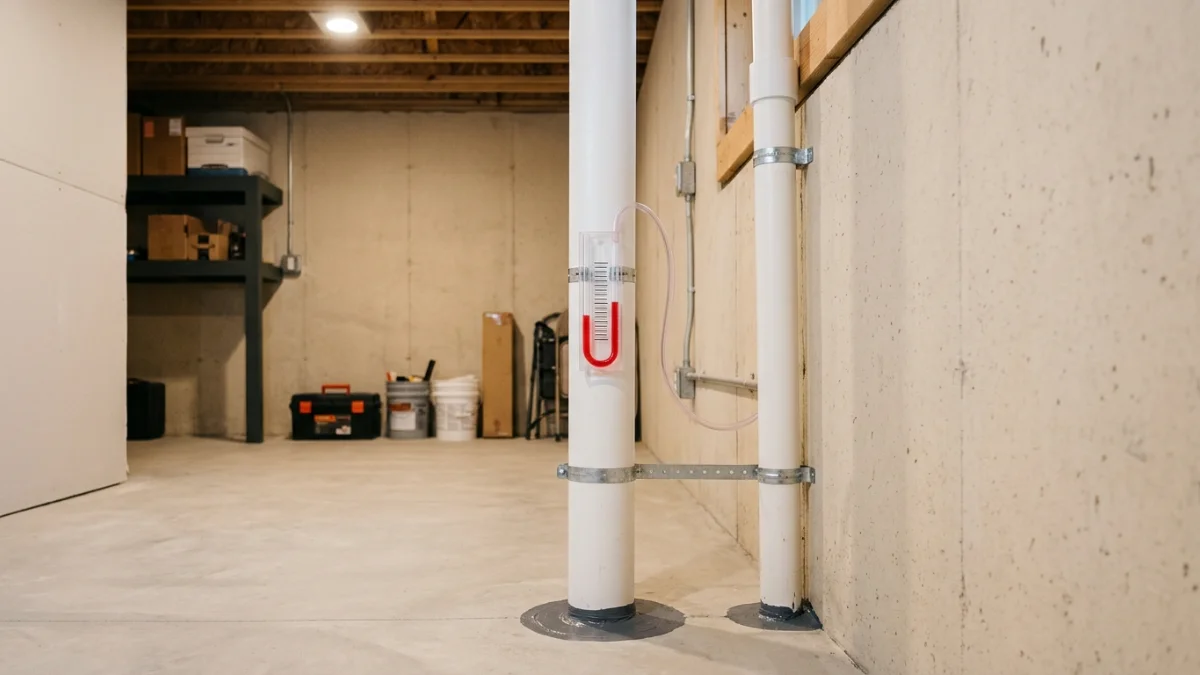
- PVC Vent Stack & U-Tube Manometer: A 3-inch or 4-inch Schedule 40 PVC pipe is sealed into the slab penetration with elastomeric polyurethane caulk. An eye-level U-tube liquid pressure gauge (manometer) is mounted on the vertical pipe in the basement so you can visually verify negative vacuum pressure (typically 0.5 to 1.8 inches of water column) at any time.
- Unoccupied Attic or Exterior Fan Placement: Under ANSI/AARST SGM-SF-2023 national radon standards, the inline radon fan must never be installed inside the conditioned basement or living area, because a positive-pressure leak on the exhaust side of the fan could blow concentrated radon gas indoors. The fan is mounted either on the exterior wall of the home or inside an unconditioned attic above the garage.
- Above-Roofline Exhaust Discharge: The exhaust pipe terminates at least 12 inches above the roof eave and at least 10 feet away from any operable window, door, or mechanical fresh-air intake.
Monthly Cost of a Radon Mitigation System (Electricity & Upkeep)
Homeowners frequently ask about the ongoing monthly cost of a radon mitigation system because the inline fan must run 24 hours a day, 365 days a year. Turning the fan off allows soil gas pressure to rebuild beneath the slab within 12 to 24 hours.
Fortunately, modern EC-motor radon fans (such as the Festa AMG Maverick, RadonAway RP145, or Fantech Rn2) consume only 40 to 75 watts during continuous operation. At the 2026 U.S. residential electricity average of $0.175 per kWh:
- 50-Watt Low-Suction Fan (Gravel Sub-Slab): Uses ~438 kWh/year = $6.38 per month ($76.65/year).
- 85-Watt High-Suction Fan (Tight Clay Soil): Uses ~745 kWh/year = $10.86 per month ($130.30/year).
- Conditioned Air Loss Penalty: Because the system pulls a small amount of conditioned indoor air down through slab seams, the EPA estimates an additional $25 to $45 per year in winter heating and summer cooling load—a cost that drops significantly if you seal major floor-to-wall joints and sump lids.
HSA / FSA Eligibility & Real Estate Escrow Credits
Did you know? Under IRS Publication 502 (Medical and Dental Expenses), if a licensed physician provides a Letter of Medical Necessity recommending radon mitigation to prevent radon-induced illness, the radon mitigation system installation cost may qualify for reimbursement through a Health Savings Account (HSA) or Flexible Spending Account (FSA). Furthermore, in residential home sales where an inspection test exceeds 4.0 pCi/L, buyers routinely negotiate a $1,500 to $2,000 seller closing credit to cover full turnkey installation.
Combining Radon Mitigation with Sump Pumps & Crawl Spaces
If your basement already has an open sump pump pit, an uncovered basin acts as a direct chimney for soil radon gas. During mitigation, technicians replace the slotted plastic sump cover with an airtight, clear polycarbonate radon dome fitted with rubber grommets for the discharge pipe and power cords. If your home has both a basement and an adjoining dirt crawl space, you will likely need a combined sub-slab and sub-membrane system—see our 2026 crawl space encapsulation cost guide and our basement waterproofing guide for integrated drainage pricing.
Always verify that your contractor holds active certification from either the National Radon Proficiency Program (NRPP) or the National Radon Safety Board (NRSB), and demand a written performance warranty guaranteeing post-installation levels below 2.0 to 3.9 pCi/L. You can compare certified radon mitigation installers and guaranteed <4.0 pCi/L quotes in your state today.
Frequently Asked Questions (2026 US Consumer Guide)
1. At what radon level is a mitigation system required?
The U.S. EPA sets the federal action level at 4.0 pCi/L and recommends considering mitigation for readings between 2.0 and 3.9 pCi/L (the World Health Organization recommends mitigating at 2.7 pCi/L). In real estate transactions, mortgage lenders and buyers almost universally require remediation at 4.0 pCi/L or higher.
2. How long does it take to install a radon mitigation system?
A standard residential sub-slab depressurization system is completed in 3 to 5 hours by a one- or two-person crew. Post-mitigation clearance testing begins 24 hours after the fan is turned on and runs for 48 hours.
3. How long does a radon mitigation fan last, and what does replacement cost?
Inline radon fans run continuously and typically last 7 to 12 years (most carry a 5-year manufacturer warranty). Replacing a worn-out fan on an existing PVC stack costs $250 to $425 including labor, or $135 to $190 for the fan unit alone.
4. What does the U-tube gauge on my radon pipe mean if both sides are at zero?
The U-tube manometer measures vacuum pressure inside the pipe, not the radon level itself. If the colored liquid levels in both sides of the U-tube are equal at zero, the fan has lost power, tripped its circuit breaker, or failed, and requires immediate inspection.
Recommended U.S. Cost & Coverage Guides
- French Drain Installation Cost in 2026: Interior vs Exterior Basement Waterproofing Pricing
- Helical Piers Cost in 2026: Foundation Underpinning & Per-Pier Installation Pricing
- Crawl Space Encapsulation Cost in 2026: 20-Mil Vapor Barrier, Dehumidifier & Per-Sq-Ft Pricing
- Standby Whole-House Generator Installation Costs in 2026: Natural Gas vs Propane, Automatic Transfer Switches, and Contractor Quotes