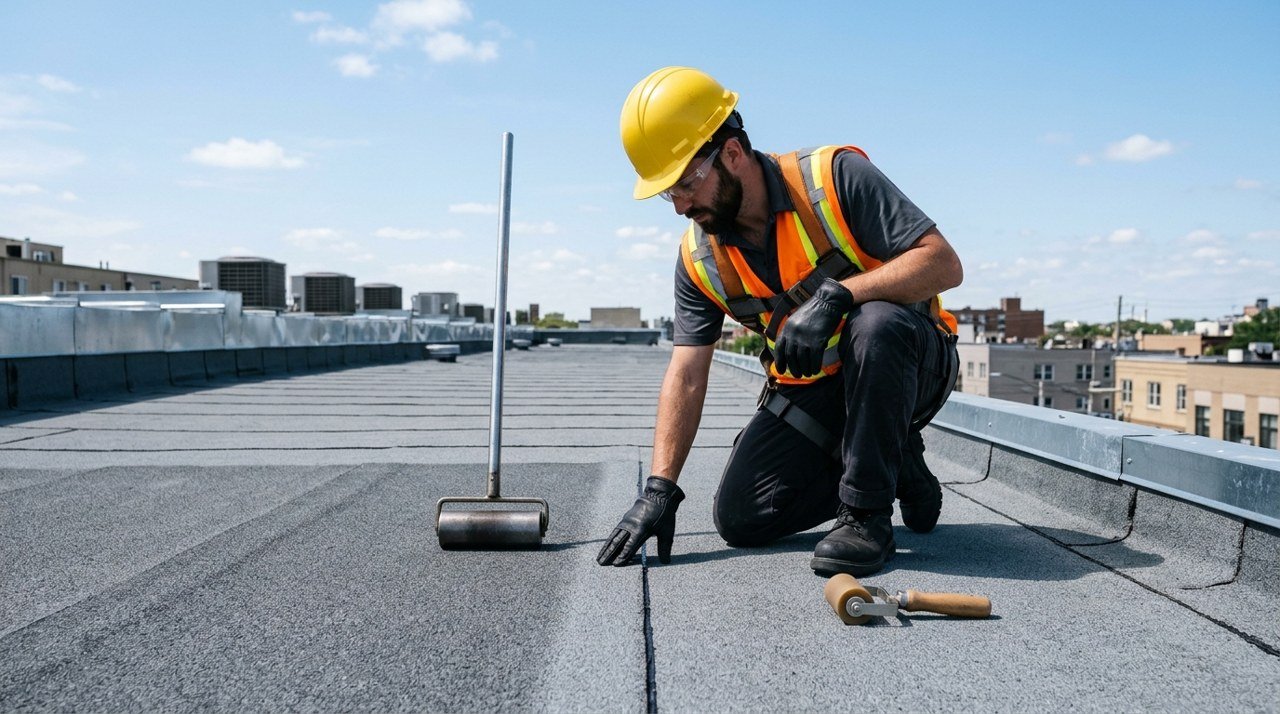
2026 Modified Bitumen Roof Repair Cost: Spot-patching a seam split, blister, or flashing leak on a modified bitumen (“mod-bit”) flat or low-slope roof averages $450 to $1,650. Larger sections or silicone/elastomeric restoration coatings run $2.50 to $4.50 per sq ft, while full two-ply SBS/APP tear-off and replacement costs $5.50 to $9.50 per sq ft.
Modified Bitumen Repair vs. Coating vs. Replacement Pricing (2026)
| Repair Scope | 2026 Average Cost | Expected Extension / Lifespan | When It Makes Sense |
|---|---|---|---|
| Localized Seam / Blister Patch (Up to 25 sq ft) | $450 – $1,200 | 3 – 7 years | Isolated storm puncture, open lap seam, or vent boot leak |
| Flashing & Parapet Wall Resealing | $650 – $1,800 | 5 – 10 years | Leaks along HVAC curbs, skylights, or brick parapet walls |
| Silicone / Elastomeric Roof Coating (Full Roof) | $2.50 – $4.50 / sq ft | 10 – 15 years | Granule loss & minor hairline crazing on dry decking |
| Full 2-Ply Mod-Bit Replacement | $5.50 – $9.50 / sq ft | 18 – 25 years | Saturated insulation board, widespread alligatoring, ponding |
SBS (Cold-Adhesive / Peel-and-Stick) vs. APP (Torch-Down) Repairs
- Match the repair method to your existing ply: APP-modified bitumen uses plastic polymers designed for heat-welded torch application, whereas SBS-modified bitumen uses rubberized asphalt applied via cold adhesive, hot mop, or self-adhered sheets.
- Never smear hardware-store tar over EPDM or TPO: Asphalt roof cement permanently swells and destroys rubber EPDM or plastic TPO roofs; confirm your roof is truly granulated modified bitumen before patching.
- Fix ponding water within 48 hours: Standing water deeper than 1/4 inch after 48 hours accelerates UV breakdown and winter freeze-thaw seam splits — ask your roofer to add tapered polyiso crickets near scuppers or drains.
Frequently Asked Questions
Can you patch a modified bitumen roof yourself without a torch?
Yes. For small non-structural repairs on dry sunny days, contractors often use SBS self-adhered cap sheet or polyester-reinforced flashing mastic rather than an open propane torch (which carries serious fire-hazard rules near wood roof decks and parapet flashings).
When a Silicone Coating Beats Tear-Off
If an infrared moisture scan confirms your underlying polyiso insulation and wood or steel decking are still dry, cleaning the existing granulated mod-bit surface and applying a high-solids 100% silicone roof coating can add 10–15 leak-free years at roughly half the cost of a full tear-off while qualifying as a maintenance expense on commercial properties. Before choosing between patching, coating, or full tear-off, have a certified commercial or flat-roof specialist inspect parapet wall copings, roof drains, HVAC pitch pockets, and perimeter drip edges where more than 80% of flat-roof leaks actually originate.
Annual Flat-Roof Maintenance Checklist to Avoid $10,000+ Tear-Offs
Clear leaves and debris from scuppers and interior roof drains every spring and fall, re-caulk cracked pitch pockets annually, and trim overhanging tree branches that drop sap or scrape protective ceramic granules off the top cap sheet. Always confirm whether your commercial or residential flat-roof warranty requires documented biannual inspections to stay valid after severe hailstorms or high-wind events to preserve full manufacturer labor and material warranty coverage.
2026 Modified Bitumen Flat Roof Repair Costs by Method
Modified bitumen (“mod-bit”) remains a workhorse on low-slope residential porches, rowhouses, and small commercial roofs, and targeted repairs in 2026 generally run between $425 and $1,650 per service visit. On a unit basis, patching blisters, open laps, or punctured cap sheets costs $4.75 to $9.50 per square foot depending on whether the crew uses traditional propane torch-down welding, cold-applied adhesive, or peel-and-stick SBS sheets. Because modified bitumen uses multi-ply asphalt reinforced with fiberglass or polyester matting, small repairs hold up reliably for 7 to 12 years when properly primed and surfaced.
Torch-Down vs. Cold-Applied vs. Self-Adhered Patching
Contractors select among three application methods based on roof deck material, fire ordinances, and existing membrane age:
- Torch-Down (APP or SBS Welding): Averaging $5.50 to $9.50 per sq. ft. (minimum $650 callout), propane torch welding melts the underside bitumen directly into the base sheet, creating a seamless waterproof bond. Many urban fire codes forbid open-flame torches near wooden parapet walls or combustible decking, requiring a 1-hour post-work fire watch.
- Cold-Applied Asphalt Adhesive: Running $4.75 to $8.25 per sq. ft., cold-process mastics bond SBS modified sheets without open flames, making them ideal around roof-mounted HVAC units, skylights, and tight parapet corners.
- Self-Adhered (“Peel-and-Stick”) SBS Rolls: Useful for quick dry-weather repairs at $4.50 to $7.50 per sq. ft., though surfaces must be above 50°F and coated with asphalt primer so edges do not lift during winter freezes.
Spotting Failures Early—and Knowing When to Patch vs. Recoat
Most mod-bit leaks do not start in the middle of a flat sheet; they begin at seams, perimeter drip edges, and flashing transitions:
- Alligatoring and Granule Loss: UV rays dry out smooth-surfaced asphalt over time, creating cracked “alligator skin” patterns. If the underlying fiberglass mat is intact, applying an aluminum fibered roof coating or elastomeric acrylic restoration system ($2.25 to $4.25 per sq. ft.) restores reflectivity and stops surface micro-cracking.
- Blisters and Ridges: Trapped moisture vapor expands on hot afternoons, lifting bubbles beneath the cap sheet. Leave minor intact blisters alone until cracked; once split, crews cut an X-flap, dry the substrate, torch or cement a patch extending 6 inches past all cut edges, and broadcast matching ceramic granules over exposed bleed-out asphalt.
- Ponding Water Rule of Thumb: If puddles sit deeper than 1/4 inch 48 hours after rain, ask your roofer to install tapered polyiso crickets ($6 to $11 per sq. ft.) or clear clogged scuppers before patching, otherwise standing water will prematurely rot asphalt seams.
Recommended U.S. Cost & Coverage Guides