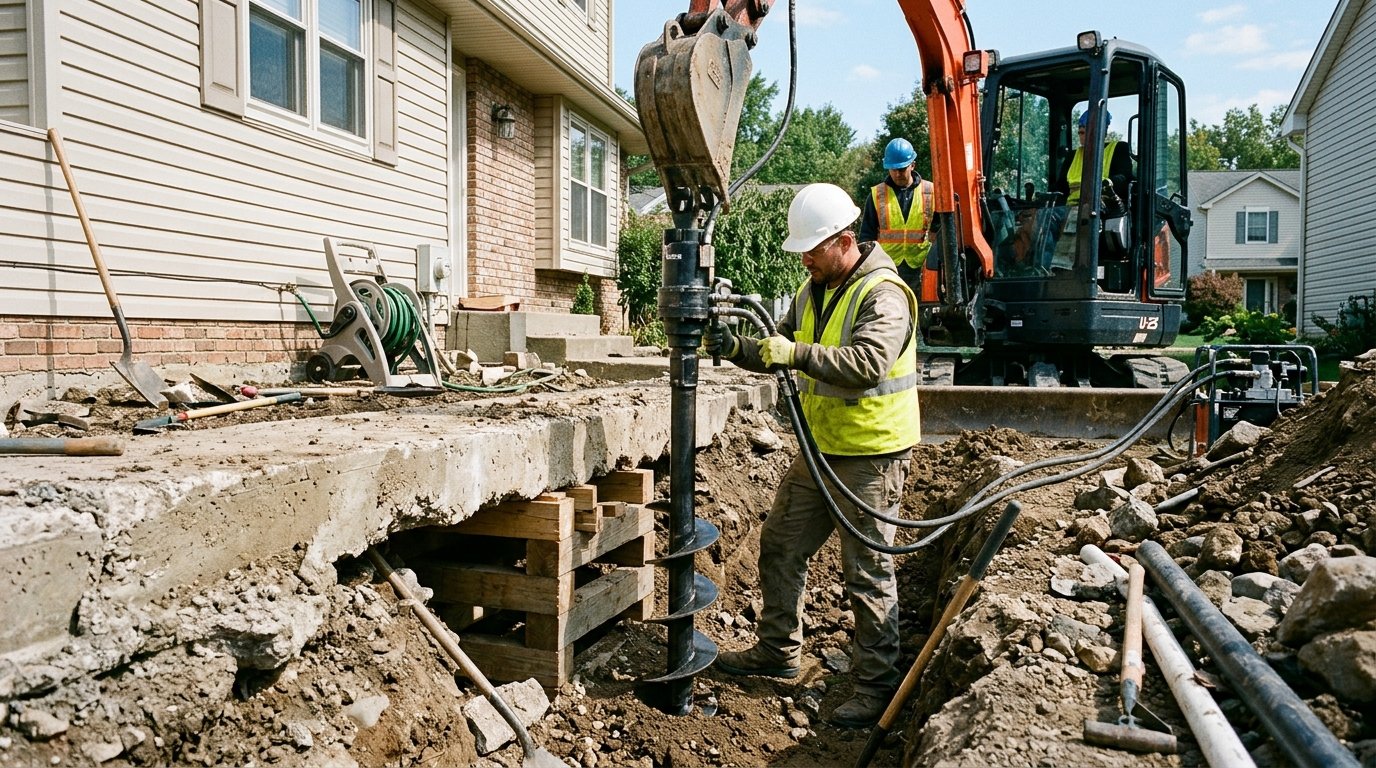
Foundation settlement is among the most stressful structural challenges an American homeowner can face. When unstable soil beneath your footings begins to shift, installing helical piers offers an engineered, permanent stabilization method. But what is the realistic helical piers cost in 2026, and how does per-pier pricing translate into your total project estimate?
Quick Takeaway: 2026 Average Pricing
In 2026, the average national cost per helical pier ranges from $1,400 to $3,200 installed. A typical residential project requiring 6 to 10 piers to stabilize a settled corner or foundation wall generally totals between $9,500 and $24,000, including structural engineering evaluations and municipal permitting.
What Are Helical Piers and How Do They Work?
Helical piers (also known as helical piles or screw anchors) are heavy-duty galvanized steel shafts equipped with circular screw-like plates (helices) welded along the shaft. Using hydraulic torque machinery, certified foundation contractors mechanically rotate the pier deep into the earth until it reaches solid, load-bearing strata or bedrock well beneath shifting surface soils.
Once the required hydraulic torque depth is reached—confirming its load-bearing capacity according to geotechnical standards—a high-strength steel foundation bracket is bolted beneath your home’s footing, transferring the structural weight from weak surface soil directly onto the deeply anchored steel piers.
2026 Helical Piers Cost Breakdown by Project Scope
Pricing varies based on structural weight, load requirements, and the depth required to reach bedrock:
| Project Scope / Application | Typical Pier Count | Average Cost Per Pier | Total Project Estimate (2026) |
|---|---|---|---|
| Porch, Deck, or Light Addition Stabilization | 2 to 4 piers | $1,200 – $1,800 | $2,800 – $6,500 |
| Corner or Single-Wall Settlement Repair | 5 to 8 piers | $1,400 – $2,400 | $8,500 – $18,000 |
| Comprehensive Home Underpinning (Two+ Walls) | 9 to 14 piers | $1,600 – $2,800 | $16,000 – $34,000 |
| Heavy Multi-Story / Deep Soil Strata (30+ ft) | 12 to 20 piers | $2,200 – $3,200+ | $28,000 – $55,000+ |
Helical Piers vs. Resistance Push Piers: Key Differences
Homeowners evaluating underpinning solutions frequently encounter two primary options: helical piers and hydraulic push piers:
- Weight Requirement: Resistance push piers require the substantial dead weight of the home to drive the steel pipes downward. Helical piers, by contrast, are self-advancing via rotational torque, making them ideal for single-story structures, crawl spaces, and lighter residential framing.
- Installation Precision: Because helical piers monitor torque continuously during drilling, contractors can calculate the exact load-bearing capacity at every foot of penetration.
- Vibration and Excavation: Helical screw installation produces minimal soil disturbance and vibration, protecting adjacent walls, plumbing runs, and landscaping.
Pro Tip: Independent Structural Engineer
Before signing a contractor contract, hire an independent licensed professional engineer (PE) for $500–$900. An unbiased engineering report specifies the exact number of piers and target depth needed, preventing contractors from overselling unnecessary piers.
Frequently Asked Questions About Helical Piers Cost
How long do helical piers last?
Modern galvanized steel helical piers are engineered to last over 75 to 100 years. Most reputable foundation repair contractors offer a transferable lifetime warranty on the pier installation.
Does homeowners insurance cover helical pier installation?
Standard homeowners insurance policies (HO-3) generally exclude earth movement, settling, and soil subsidence. However, if settlement resulted from a sudden covered peril (such as a burst interior pipe washing out soil), a portion of the tear-out or repair might be covered.
How long does the installation take?
A typical residential helical pier installation of 6 to 10 piers is completed within 2 to 4 working days, causing minimal disruption compared to full foundation rebuilds.
2026 Helical Pier Installation Pricing and Real Project Budgets
When expansive clay soils or poorly compacted fill cause stair-step brick cracks, sticking doors, or sloping floors, helical piers (steel screw piles) offer a permanent engineering fix without pouring massive concrete footings. In 2026, residential helical pier underpinning typically costs $1,400 to $2,500 per pier installed, including the galvanized steel lead section, extensions, heavy-duty underpinning bracket, and hydraulic torque installation. Stabilizing a single bowing or sinking garage wall usually requires 6 to 8 piers ($9,000 to $18,000), while underpinning an entire perimeter or multi-story corner averages $22,000 to $42,000+.
4 Site Factors That Change Your Per-Pier Quote
- Depth to Load-Bearing Soil: Base estimates generally cover 14 to 21 feet of steel shaft. If soft clay, high water tables, or deep fill soil force crews to drive piers 35 to 55 feet deep before hitting competent strata, expect $65 to $110 per linear foot for extra 5- or 7-foot extension sections.
- Equipment Access and Interior Work: Tight side yards narrower than 48 inches, low decks, or interior basement slabs that require portable hand-held drive heads and hand-excavated underpinning pits add $300 to $600 per pier in labor.
- Engineering Stamps and Permits: Independent structural engineer drawings ($1,000 to $2,500) and municipal building permits ($250 to $900) are frequently listed as separate line items outside the contractor’s per-pier rate.
- Concrete and Landscape Restoration: Saw-cutting and repouring driveways, re-sealing exterior waterproofing membranes, and reconnecting perimeter French drains typically add $1,500 to $4,000 to the final invoice.
Contractor Vetting Checklist Before Signing
- Verify hot-dip galvanized steel: Uncoated bare steel corrodes faster in acidic or wet soils; confirm ASTM-compliant galvanized shafts and brackets in your written contract.
- Require digital torque logs: Installers should record installation torque (often 4,000 to 6,000+ ft-lbs) at every pier to prove verified load capacity before locking brackets onto the footing.
- Separate stabilization from lifting: Clarify whether your price covers halting future movement or actively jacking the foundation back to level, which can crack interior drywall, pop tile grout, and strain rigid plumbing pipes.
- Confirm a transferable lifetime warranty: Written transferability protects your home’s resale value during future buyer inspections and lender appraisals.
Recommended U.S. Cost & Coverage Guides
- Affordable Solar Panel Installation Services Near You
- Kitchen Cabinet Refacing vs. Replacement Cost (2026): Real Price & ROI Breakdown
- Basement Waterproofing Cost in 2026: Interior vs Exterior Drain Tile, Sump Pumps & Vapor Barriers
- Stair Lift Cost for Seniors in 2026: Straight vs Curved Rail Pricing, Installation Fees & Medicare/VA Grants