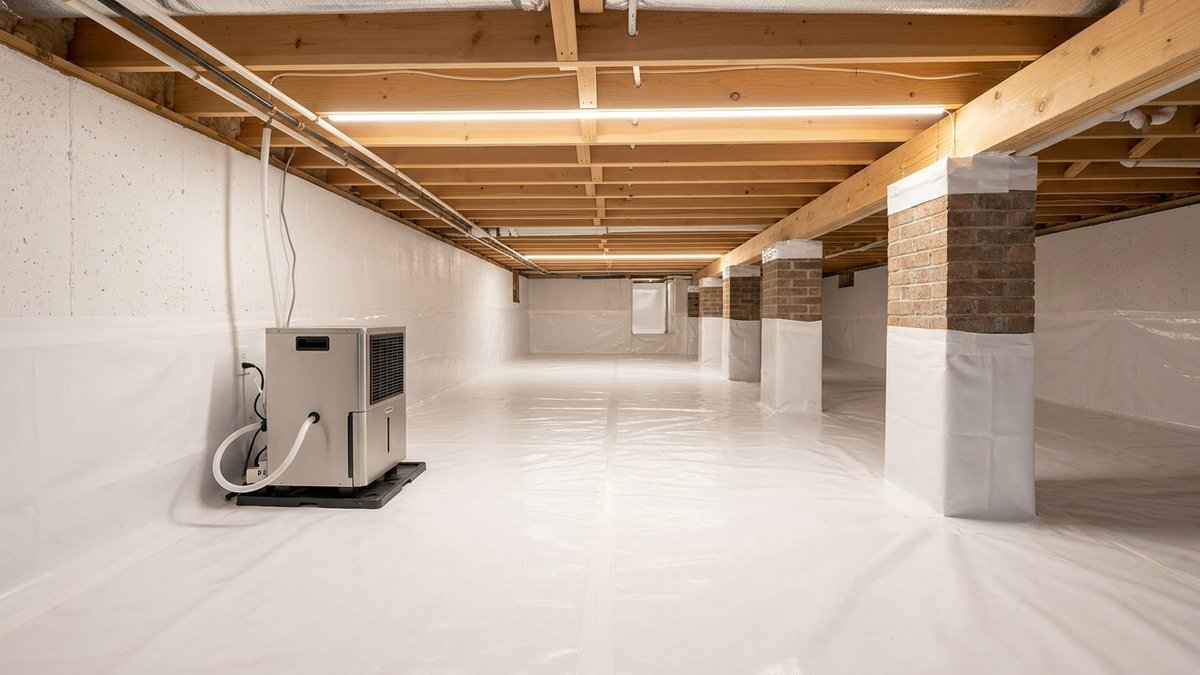
Under the foundational building science principle known as the “Stack Effect,” approximately 50% of the air circulating across your first floor, living room, and bedrooms is drawn directly upward from your foundation crawl space. In traditional dirt crawl spaces, ground moisture continuously evaporates into the air, creating a humid microclimate exceeding 80% relative humidity. This breeds wood-decaying white and black fungi, rots floor joists, and attracts subterranean termites and rodents. Full crawl space encapsulation converts this dark, damp sub-floor void into a clean, conditioned thermal envelope. Here is an objective 2026 engineering cost breakdown of crawl space encapsulation cost, vapor barrier grades, and energy payback.
Quick Takeaway: 2026 Crawl Space Encapsulation Costs
In 2026, the national average crawl space encapsulation cost is $5,800 to $12,500, or $3.50 to $8.50 per square foot for complete ground and wall coverage. Basic plastic vapor barrier replacements on dry crawl spaces run $2,200 to $4,000, while high-performance encapsulation packages including a commercial-grade 20-mil string-reinforced vapor barrier, closed-cell foam wall insulation, perimeter drainage, and a dedicated low-grain refrigerant dehumidifier average $9,500 to $16,000+.
Cost Breakdown by Encapsulation Package Tier in 2026
| Tier Level & Specifications | Cost per Square Foot | Average Cost (1,200 sq ft) | Components Included |
|---|---|---|---|
| Basic Vapor Barrier (Non-Conditioned) | $2.00 – $3.50 / sq ft | $2,400 – $4,200 | Loose-laid 6-to-10 mil plastic on dirt, ground spikes (vents left open) |
| Standard Encapsulation System | $4.50 – $7.00 / sq ft | $5,400 – $8,400 | Taped 12-mil barrier up walls, sealed foundation vents, airtight entry door |
| Premium Full Conditioned Envelope | $7.50 – $11.50 / sq ft | $9,000 – $13,800 | Heavy 20-mil poly, wall spray foam, smart dehumidifier, sump pump basin |
Pro Tip: Vapor Barrier Thickness Matters (Why 20-Mil Is Essential)
Cheap contractor-grade 6-mil polyethylene sheet tears easily when HVAC technicians or plumbers crawl over sharp gravel or masonry chips. Once punctured, moisture vapor rushes through. Insist on a minimum 12-mil to 20-mil virgin polyethylene barrier reinforced with high-strength polyester cord grid. It resists punctures, features antimicrobial additives, and carries a 25-to-50-year manufacturer warranty.
Mandatory Pre-Treatment: Fungal Remediation and Termite Inspections
Never install heavy polyethylene vapor barrier over active wood rot or existing fungal colonies. Sealing moisture-loving mold spores behind airtight plastic creates an incubation chamber that accelerates framing rot. Before pinning plastic to masonry walls, professional contractors perform an EPA-registered antimicrobial wood wash and apply a borate wood preservative (such as Bora-Care) across all sub-floor joists and sills.
Furthermore, state building codes require a 3-inch termite inspection gap left bare at the top of interior foundation walls, ensuring pest control inspectors can verify that subterranean termites are not constructing hidden mud tubes behind the barrier.
Return on Investment: Energy Savings and Structural Protection
Encapsulating a crawl space delivers substantial measurable financial returns:
- 15% to 22% Reduction in Heating & Cooling Bills: In winter, freezing air no longer cools ducts beneath floorboards; in summer, humid air is locked out, dramatically lowering HVAC air conditioning run-times.
- HVAC Longevity: Ductwork located in sealed crawl spaces operates in a clean, temperature-moderated environment, preventing interior duct condensation.
- Preservation of Hardwood Flooring: Prevents floor joist cupping, crowning, and hardwood floor squeaks caused by seasonal humidity cycling.
Foire Aux Questions (FAQ) / Frequently Asked Questions
What does IRC code require for crawl space conditioning?
Under the International Residential Code (IRC R408.3), an encapsulated crawl space must either incorporate a continuously operated mechanical exhaust system (1 CFM per 50 sq ft of space) or receive conditioned supply air from your home’s central HVAC system (1 CFM per 50 sq ft) with an airtight insulated access hatch.
Should crawl space vents be open or closed?
Modern building science and current International Residential Code (IRC) section R408.3 confirm that traditional vented crawl spaces are fundamentally flawed in humid regions. During summer, warm humid air enters vents and condenses against cooler subterranean walls and HVAC ducts. Closing and sealing vents during encapsulation permanently eliminates this condensation cycle.
Do I need a dehumidifier after encapsulating?
Yes. A sealed crawl space is an airtight container. Even with a 20-mil vapor barrier, concrete block walls and structural framing naturally release trace moisture. A dedicated commercial crawl space dehumidifier (70 to 90 pints per day, costing $1,400 to $2,200 installed) maintains indoor relative humidity safely below 50% automatically.
How long does the encapsulation installation process take?
A full professional encapsulation for an average 1,200 sq ft home takes 2 to 4 business days: 1 day for debris cleanup and ground leveling, 1 to 2 days for vapor barrier pinning and vent sealing, and 1 day for electrical dedicated circuit wiring, condensate line plumbing, and dehumidifier calibration to ensure optimal relative humidity.
Recommended U.S. Cost & Coverage Guides
- Home Solar Battery Storage Cost (2026): Tesla Powerwall vs. Enphase & 30% Credit
- Mold Remediation Cost in 2026: Basement, Attic & Crawl Space Removal Prices Per Square Foot
- Spray Foam Insulation Cost in 2026: Open-Cell vs Closed-Cell Price Per Board Foot & Energy Tax Credits
- Walk-In Tubs for Seniors Cost in 2026: Installation Pricing, Hydrotherapy Features & Medicare Coverage