Sticking interior doors that refuse to latch, stair-step cracks migrating through exterior brick mortar joints, sloping hardwood floors, and gaps widening between crown molding and drywall are the classic warning signals of differential foundation settlement. Because your foundation bears the entire structural dead-load of your framing, roof, and mechanical systems, soil subsidence or expansive clay movement can rapidly compromise habitability and erase 20% to 30% of your home’s equity. Here is an objective 2026 engineering analysis of foundation repair cost across hydraulic piering, slab jacking, carbon fiber reinforcement, and drainage stabilization.
Quick Takeaway: 2026 Foundation Repair Cost Benchmarks
In 2026, the national average foundation repair cost is $4,800 to $9,200, with minor non-structural epoxy crack sealing running $500 to $1,500 and major hydraulic underpinning for settling homes costing $10,000 to $25,000+. Hydraulic push piers cost $1,400 to $2,200 per pier installed, while sunken concrete slab leveling averages $1,200 to $2,800.
Cost Breakdown by Foundation Repair Method in 2026
The corrective engineering method chosen depends entirely on whether the failure is vertical soil settlement, lateral hydrostatic bowing, or concrete shrinkage:
| Repair Method / Technology | Target Failure Mode | Unit Pricing (2026) | Average Total Project Cost |
|---|---|---|---|
| Epoxy & Polyurethane Crack Injection | Non-structural hairline & water-leaking cracks | $400 – $800 / crack | $800 – $1,600 |
| Polyurethane Foam Slab Jacking (Polylifting) | Sunken slab-on-grade, garage aprons, sidewalks | $10 – $22 / sq ft | $1,400 – $3,200 |
| Carbon Fiber Straps (Staples & Mesh) | Bowing basement walls (< 2 inches inward deflection) | $750 – $1,150 / strap | $4,500 – $8,500 (6–8 straps) |
| Hydraulic Steel Push Piers / Helical Piers | Vertical foundation settling & sinking footings | $1,400 – $2,200 / pier | $11,200 – $22,000 (8–12 piers) |
| Steel I-Beam Wall Bracing | Severe inward wall deflection (> 2 inches) | $800 – $1,400 / beam | $6,000 – $12,000 |
Pro Tip: Always Commission an Independent Structural Engineer Report
Foundation repair salespeople frequently work on commission and often recommend excessive 12-pier underpinning packages when minor drainage remediation and crack sealing would suffice. Invest $500 to $900 in a licensed, independent Professional Structural Engineer (PE). A PE has zero financial stake in selling you piers and will draft an unbiased, stamped repair plan that contractors must bid against accurately.
Cosmetic Hairline Cracks vs. Severe Structural Failure: How to Tell
Nearly all concrete foundations experience minor shrinkage cracks as concrete cures during the first two years after construction. Understanding how to distinguish harmless settlement from emergency structural movement saves thousands in misdiagnosed contractor bids:
- Vertical Hairline Cracks (< 1/16 inch wide): These are almost universally cosmetic curing cracks resulting from concrete shrinkage. They do not threaten structural capacity. Injecting flexible polyurethane ($400-$700) to block ground moisture or radon gas infiltration is generally sufficient.
- Horizontal Cracks in Basement Block or Poured Walls: A horizontal fracture developing midway up a foundation wall is an unmistakable symptom of excessive lateral hydrostatic pressure. Saturated clay soil outside is pushing the wall inward. This requires carbon fiber strapping or steel I-beams before the wall collapses.
- Stair-Step Cracks in Exterior Brick / Mortar: When cracks follow mortar lines in a zigzag pattern, differential foundation sinking is actively occurring. One corner or wall section is settling deeper than the rest of the footing.
- Doors Sticking Along Top Jambs and Floor Sloping: If doors begin sticking at an angle or baseballs roll spontaneously across hardwood floors, the footing has dropped by half an inch or more, demanding hydraulic steel pier underpinning.
Preventive Exterior Drainage Solutions: French Drains and Downspout Extensions
The root catalyst behind 85% of all residential foundation failures is improper surface water management. When gutter downspouts discharge roof runoff within 2 feet of foundation walls, expansive clay soils swell like a sponge; during summer droughts, the clay shrinks and pulls away from the footing, causing the house to drop.
Investing $1,500 to $3,500 in exterior French drains, buried 10-foot downspout extensions, and re-grading soil with a 5% positive outward slope can permanently halt ground movement and avoid an impending $15,000 underpinning project.
Steel Push Piers vs. Helical Piers: What Is the Difference?
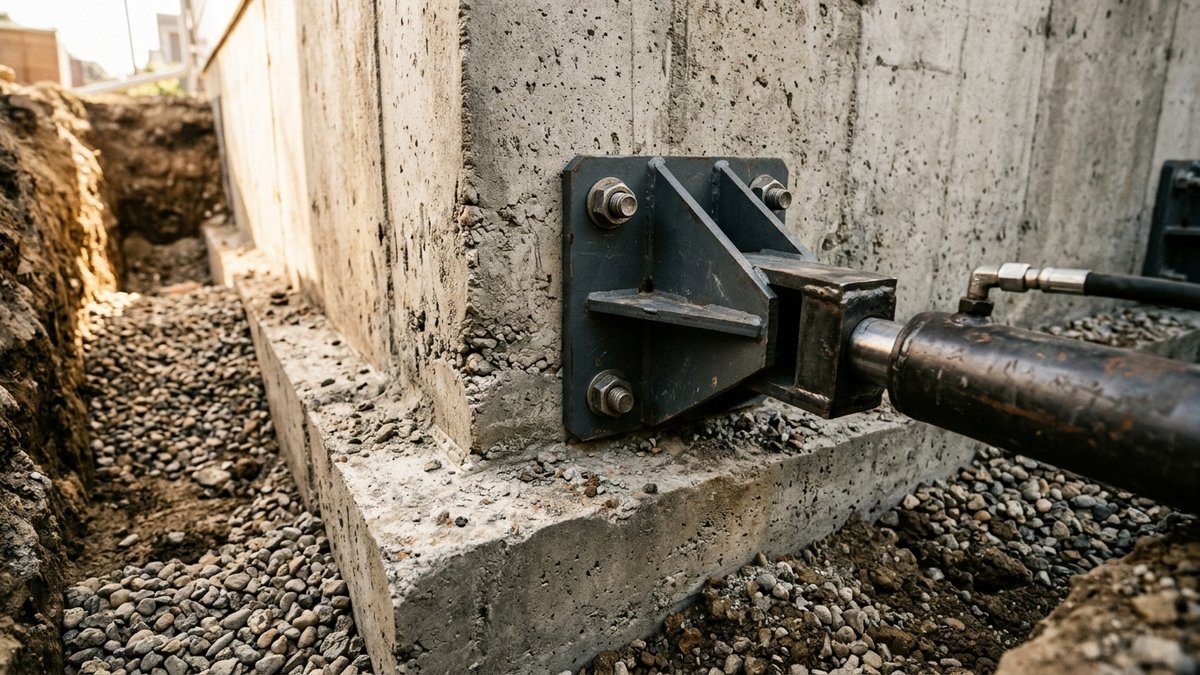
- Hydraulic Steel Push Piers: Driven hydraulically into load-bearing bedrock or hardpan stratum using the weight of the structure itself as reaction mass. They are the gold standard for heavy residential two-story structures settling into deep soil.
- Helical Piers: Feature welded helix screw plates and are torqued mechanically into the earth like giant corkscrews. They are ideal for lighter slab-on-grade homes, porches, light commercial builds, or areas where bedrock is shallow.
Foire Aux Questions (FAQ) / Frequently Asked Questions
Can I sell a house that has experienced foundation repair?
Yes. Fully repaired and engineered foundations are routine in residential real estate. Most reputable foundation contractors provide transferable lifetime warranties on their steel pier systems. Having a stamped structural engineer completion report showing stabilization actually reassures mortgage underwriters and home appraisers.
Does homeowners insurance cover foundation repair costs?
In 95% of cases, standard homeowners insurance (HO-3) will not cover foundation repair. Settlement caused by soil compaction, drought, poor drainage, or expansive clay is considered normal ground movement and excluded. The rare exception is if foundation failure is caused by an instantaneous covered event, such as a major explosion or burst underground municipal water main.
How long does foundation piering work take to complete?
A typical residential piering installation involving 8 to 12 push piers usually takes 2 to 4 days. Excavation around the footings takes 1 day, driving piers to load-bearing depth and hydraulic lifting takes 1 to 2 days, and backfilling with clean soil/gravel takes 1 day.
What happens if I ignore foundation problems?
Ignoring foundation settlement causes cascading damage: structural plumbing drain lines snap under shear stress beneath the slab, roof trusses shift leading to chronic ceiling leaks, masonry facades buckle, and repair costs escalate from a $6,000 stabilization to a $40,000 full foundation replacement.
Recommended U.S. Cost & Coverage Guides
- Walk-In Tub Costs and Installation Guide 2026: Hydrotherapy Jets, Safety Features, and Medicare Reimbursement Facts
- Basement Waterproofing Costs & Foundation Repair: Interior Drain Tile vs Exterior Excavation
- Epoxy Garage Floor Coating: Durable, Industrial-Grade Finishes
- Kitchen Cabinet Refacing vs Replacement: Costs & Style Guide