
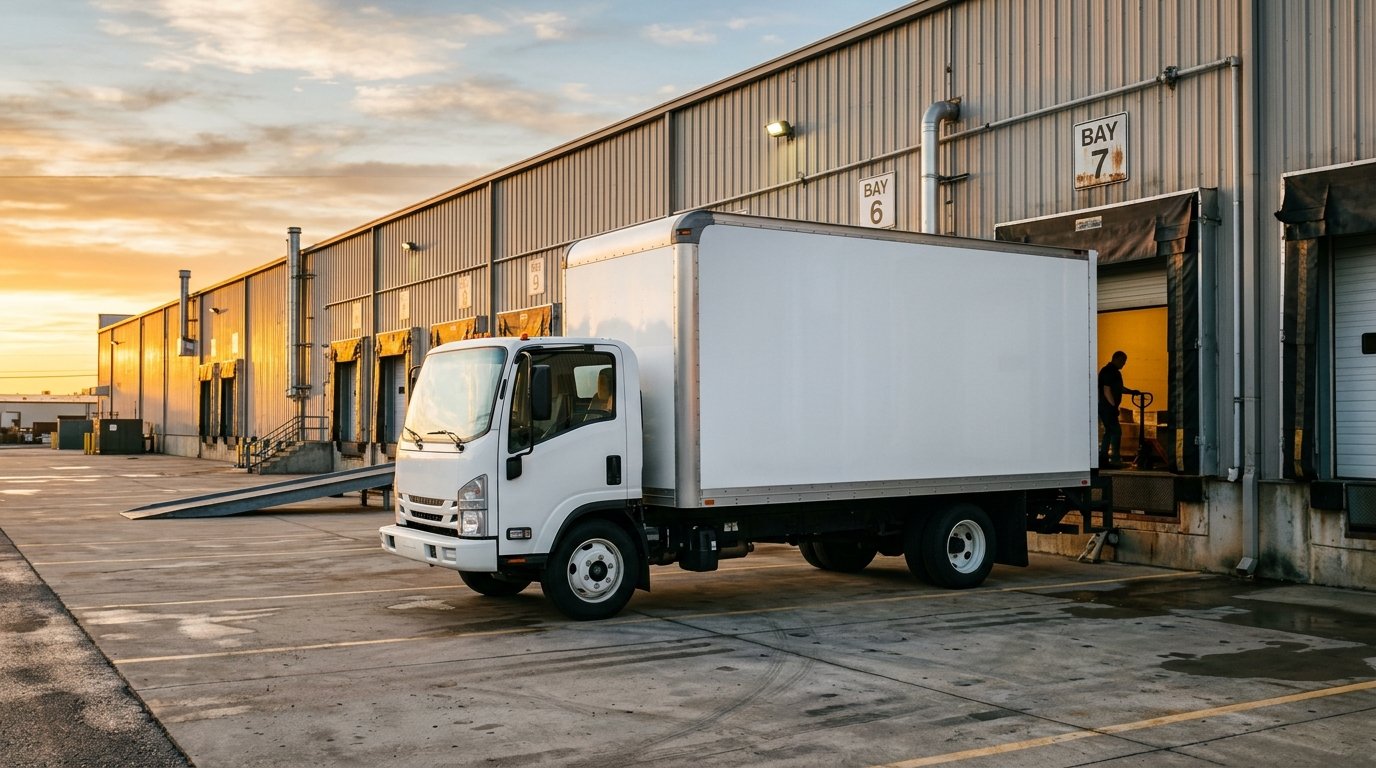
Whether operating as an independent owner-operator, running local final-mile deliveries, or managing a regional logistics fleet, securing commercial auto coverage is your largest ongoing operational expense. Understanding the average box truck insurance cost in 2026 helps owner-operators budget effectively and identify commercial coverage tailored to their routes.
Quick Benchmark: 2026 Monthly Premium Averages
In 2026, the national average commercial box truck insurance cost ranges between $350 and $1,100 per month ($4,200 to $13,200 annually per vehicle). Local non-CDL straight trucks operating within 50 miles pay near the lower end, while interstate freight carriers holding active USDOT operating authority face higher premiums.
What Determines Your Box Truck Insurance Rates?
Commercial underwriters calculate your premium by weighing several operational risk parameters:
- Operating Radius (Local vs. Regional vs. Long-Haul): Trucks confined to a 50-mile local metro radius face significantly lower crash risk than interstate haulers operating across 300+ miles.
- Vehicle Class & Weight (GVWR): Non-CDL box trucks under 26,000 lbs (such as 16-ft to 24-ft straight trucks) enjoy lower liability tiers than Class 7 and Class 8 commercial vehicles.
- Cargo Type & Valuation: Hauling dry goods, furniture, or parcel freight yields standard rates, while transporting high-theft electronics or refrigerated produce requires specialized motor truck cargo coverage.
- Driver Motor Vehicle Records (MVR): Clean commercial driving records with 2+ years of verified CDL experience qualify for substantial preferred-carrier discounts.
2026 Average Box Truck Insurance Premiums by Operation Type
| Operation Profile / Radius | Vehicle Type | Average Monthly Premium | Annual Premium Range |
|---|---|---|---|
| Local Delivery / Expedited Courier (<50 miles) | 16–22 ft Non-CDL (under 26,000 lbs) | $350 – $580 | $4,200 – $6,960 |
| Regional Freight Transport (50–250 miles) | 24–26 ft Straight Truck | $600 – $850 | $7,200 – $10,200 |
| Interstate Over-the-Road (Long-Haul) | 26 ft Heavy Commercial Straight Truck | $900 – $1,250 | $10,800 – $15,000 |
| New Authority (First Year USDOT Startup) | Any Commercial Straight Truck | $1,100 – $1,600 | $13,200 – $19,200 |
Core Coverages Every Box Truck Policy Must Include
- Primary Auto Liability ($750,000 to $1,000,000): Federal Motor Carrier Safety Administration (FMCSA) mandate covering bodily injury and property damage to third parties in an at-fault accident.
- Motor Truck Cargo ($100,000): Covers transported freight against collision, rollover, theft, and water intrusion. Freight brokers and load boards (DAT, Truckstop) universally require at least $100,000 in cargo coverage.
- Physical Damage (Comprehensive & Collision): Reimburses repair or actual cash value (ACV) replacement if your box truck is damaged in an accident, stolen, or vandalized.
How to Lower Your Commercial Rates
Equip your trucks with dual-facing dash cameras and Electronic Logging Devices (ELDs). Commercial carriers frequently provide 10% to 18% telematics safety discounts for verified driving compliance.
Frequently Asked Questions
Do I need a commercial driver’s license (CDL) for a 26-foot box truck?
If the Gross Vehicle Weight Rating (GVWR) is 26,000 lbs or less, no CDL is required under federal law. However, if the GVWR exceeds 26,001 lbs, a Class B CDL is mandatory.
Can I pay box truck insurance monthly?
Yes. Most commercial auto insurers offer flexible financing with a 15% to 20% down payment followed by 9 to 11 monthly installments.
2026 Box Truck Insurance Benchmarks: Monthly Cost by Radius and Cargo
Commercial insurance is one of the largest fixed operating expenses for a 26-foot non-CDL straight box truck (under 26,000 pounds GVWR). In 2026, underwriting depends heavily on how long your DOT/MC authority has been active, how far from your garaging ZIP code you operate, and what sits inside the cargo box. For an established operator with two or more years of clean authority carrying $1,000,000 in primary auto liability, $100,000 in motor truck cargo, and physical damage coverage, monthly benchmarks break down as follows:
- Local Radius (Under 100 to 200 Miles): Averages $650 to $1,050 per month ($7,800 to $12,600 per year). Ideal for metro pallet runs, beverage routes, and local distribution.
- Regional Radius (200 to 500 Miles): Averages $950 to $1,450 per month ($11,400 to $17,400 per year), reflecting higher highway speed exposure and overnight stops.
- Long-Haul Interstate (Over 500 Miles / 48-State): Averages $1,250 to $1,950+ per month ($15,000 to $23,400+ per year).
- New Authority Surcharge (0 to 12 Months): First-year owner-operators commonly pay $1,550 to $2,400 per month—roughly 35% to 60% above seasoned fleets—along with 20% to 25% down payments at binding.
How Cargo Class Changes Your Monthly Premium
Load boards and brokers routinely mandate $100,000 in cargo coverage, yet cargo rates vary widely by commodity theft risk and handling exposure:
- General Dry Freight & Palletized Retail: Adds roughly $75 to $135 per month with a $1,000 or $2,500 deductible.
- White-Glove Furniture, Appliances & Final-Mile Delivery: Adds $115 to $210 per month and usually requires a $1,000,000 Commercial General Liability policy ($60 to $110/month) to cover damage inside customer homes.
- Refrigerated Freight, Electronics, or High-Value Goods: Adds $160 to $310 per month and often mandates reefer-breakdown endorsements, GPS tracking, and unattended-vehicle theft warranties.
5 Proven Ways to Cut Box Truck Insurance Costs
Before binding a policy, avoid paying for an unlimited-radius endorsement if your contracts stay within 250 miles—narrowing radius pricing alone can save $1,200 to $2,400 annually. Second, keep vehicle GVWR strictly at or below 26,000 pounds unless you run CDL-verified drivers. Third, install dual-facing dashcams and share ELD telematics data to capture 5% to 12% safety credits. Fourth, raise physical-damage deductibles from $1,000 to $2,500 if your truck value exceeds $35,000. Finally, verify whether your broker requires trailer interchange or hired-auto endorsements before paying for coverage a straight truck never uses.
Recommended U.S. Cost & Coverage Guides
- Unsold SUV Clearance Sales: How to Find the Best Deals
- Commercial Fleet Insurance Cost in 2026: Per-Vehicle Rates, Telematics Discounts & USDOT Filing Guide
- Best Non-Owner SR-22 Insurance in 2026: Cheap Quotes, Filing Fees & State Rules
- Commercial Truck Insurance: Motor Carrier Primary Liability vs Physical Damage & Cargo Rates (2026)



1 thought on “Box Truck Insurance Cost in 2026: Average Monthly Rates by Cargo & Radius”