
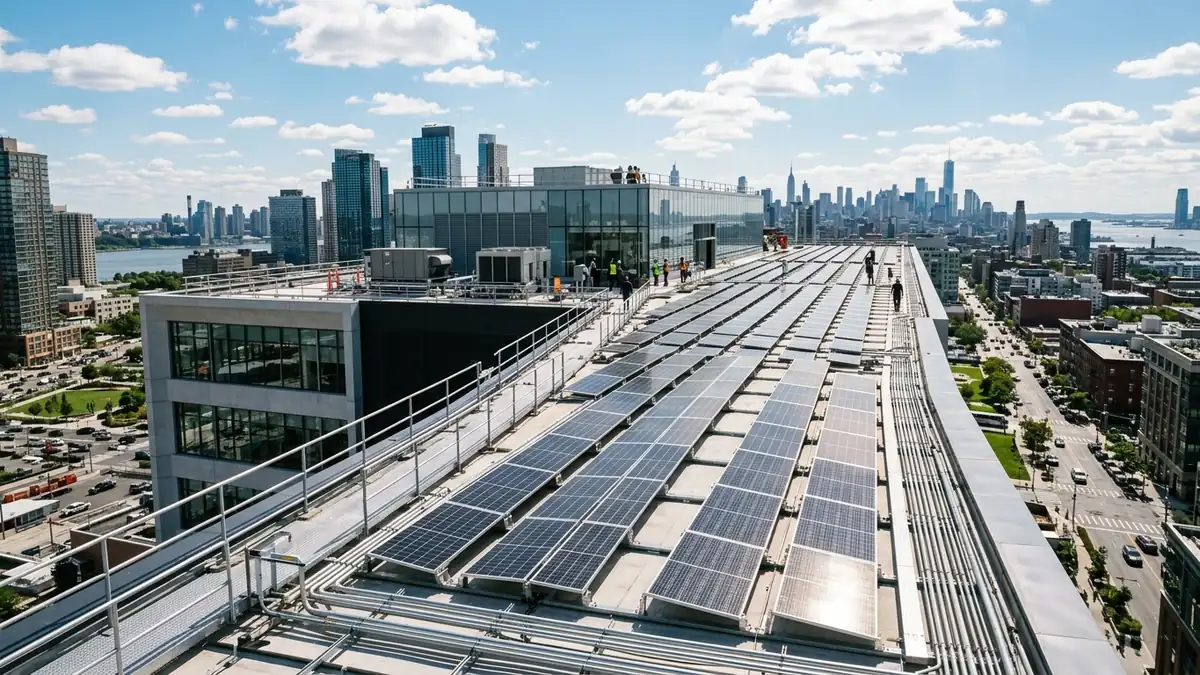
Key Takeaways:
- Section 48 Investment Tax Credit (ITC): Base 30% federal tax credit remains fully accessible in 2026, with stackable 10% adders for domestic manufacturing content and energy communities reaching up to 50%.
- MACRS Accelerated Depreciation: 5-year Modified Accelerated Cost Recovery System paired with first-year bonus depreciation allows businesses to write off nearly 85% of total system cost rapidly.
- Ownership Models Evaluated: Direct cash purchases and commercial solar loans yield the highest lifetime net savings (IRR > 18%), whereas Power Purchase Agreements (PPAs) offer zero upfront capital risk.
- Demand Charge Reduction: Coupling rooftop commercial photovoltaic (PV) arrays with commercial battery energy storage systems (C&I BESS) drastically shaves utility peak demand charges.
For commercial real estate owners, manufacturing facilities, logistics warehouses, and agricultural operations across the United States, electricity expenditures represent one of the most volatile operating costs on the balance sheet. In 2026, skyrocketing utility grid rates, combined with aggressive corporate decarbonization mandates, have turned on-site commercial solar into a vital financial arbitrage strategy rather than merely a sustainability initiative.
Backed by the long-term runway established under the federal Inflation Reduction Act (IRA), commercial photovoltaic systems benefit from an unprecedented convergence of federal tax credits, state-level renewable energy certificates (SRECs), and aggressive accelerated tax depreciation. This comprehensive guide breaks down the statutory rules governing the Section 48 Investment Tax Credit (ITC), the compounding impact of MACRS depreciation, and the mathematical trade-offs between capital-intensive direct purchases and off-balance-sheet Power Purchase Agreements (PPAs).
1. Section 48 Investment Tax Credit (ITC) Mechanics in 2026
The federal Section 48 ITC provides a dollar-for-dollar reduction in federal corporate income tax liability based on the total capital expenditure (CapEx) of qualifying commercial energy property placed in service during the tax year:
- Base Credit Rate (30%): To secure the full 30% credit rather than the 6% statutory base, commercial systems greater than 1 megawatt (MW AC) must satisfy prevailing wage and apprenticeship requirements certified by the Department of Labor during both construction and initial operation phases. Systems under 1 MW AC automatically qualify for the full 30% rate.
- Domestic Content Bonus (+10%): Projects utilizing 100% US-manufactured structural steel/iron and a minimum certified domestic threshold for manufactured components (inverters, solar cells, and tracking racks) unlock an additional 10% tax credit adder, bringing the baseline to 40%.
- Energy Community Adder (+10%): If your commercial facility is located within a brownfield site, an area with historical coal mine/plant closures, or an MSA with high employment tied to fossil fuels, you qualify for an extra 10% adder, enabling a cumulative 50% federal tax credit.
- Transferability Provisions: Under Section 6418, corporate taxpayers without sufficient tax appetite can execute clean, legally compliant credit transfers, selling their earned ITCs to third-party corporate buyers for cash (typically 90 to 94 cents per dollar of tax credit).
2. MACRS 5-Year Depreciation & Basis Reduction
Beyond the direct federal tax credit, the federal tax code treats commercial solar as 5-year property under the Modified Accelerated Cost Recovery System (MACRS). This delivers substantial front-loaded tax deductions that significantly accelerate project payback periods:
- Depreciable Basis Calculation: In accordance with Internal Revenue Code regulations, the depreciable tax basis of the solar asset is reduced by exactly half of the claimed ITC. For a standard 30% ITC, 85% of the total system cost remains eligible for MACRS depreciation.
- Bonus Depreciation Layering: Depending on prevailing phase-out schedules and federal tax provisions, businesses can write off a significant portion of the depreciable basis in Year 1, with the remainder depreciated over the 5-year MACRS schedule (20%, 32%, 19.2%, 11.52%, 11.52%, 5.76%).
- Net Corporate Effective Cost: When factoring in a combined federal and state corporate income tax rate of 25% to 30%, the depreciation shield recovers an additional 20% to 25% of the gross project cost, pushing total public-incentive cost recovery to 55%–70% within the first 18 months of operation.
3. Financial Model Comparison: Cash Purchase vs. Commercial Loan vs. PPA
| Financing Structure | Upfront Capital Outlay | Tax Credit & MACRS Beneficiary | 25-Year Net ROI / Savings | O&M Maintenance Responsibility |
|---|---|---|---|---|
| Direct Capital Purchase (Cash) | 100% of CapEx ($250k – $2M+) | Property Owner (Host Business) | Highest (IRR 18% – 24%; 3.5 – 5 yr payback) | Host business / Warranty contracts |
| Commercial Solar Loan / C-PACE | $0 to 10% Down | Property Owner (Host Business) | High (Immediate positive cash flow) | Host business / System installer |
| Power Purchase Agreement (PPA) | $0 Down (Zero CapEx) | Third-Party Solar Developer | Moderate (15% – 30% utility bill discount) | Solar Developer (Turnkey 20-25 yrs) |
| Operating / Capital Lease | Minimal upfront fee | Leasing Company / Bank | Predictable monthly lease payments | Varies by operating agreement |
4. The Power of Solar + Storage (C&I BESS) for Peak Shaving
In many commercial utility territories (e.g., California SCE/PG&E, New York ConEd, Texas ERCOT, and New England ISO-NE), electrical energy consumption (kWh) accounts for only half of the monthly electric utility bill. The remainder consists of punitive peak demand charges ($/kW) assessed on the single highest 15-minute interval of electricity draw during the billing cycle.
Standalone rooftop solar generates maximum electricity between 11:00 AM and 2:00 PM, which may not align with an industrial facility’s late afternoon operations. Integrating commercial lithium iron phosphate (LiFePO4) battery systems allows automated peak shaving: the battery discharges during sudden machine spin-ups or peak utility demand windows, permanently clipping demand peaks and saving tens of thousands of dollars annually in non-bypassable utility surcharges.
5. Commercial Property Assessed Clean Energy (C-PACE) Financing
For businesses seeking the massive long-term financial upside of direct asset ownership without depleting working capital lines or covenant ratios, C-PACE financing has emerged as the premier funding tool in over 38 states. C-PACE provides 100% upfront long-term (20 to 30-year) fixed-rate non-recourse financing that is repaid through a special property tax assessment. Because the financing attaches to the real property rather than the operating company, it does not impair commercial borrowing covenants and can be passed through to building tenants in triple-net (NNN) commercial leases.
Frequently Asked Questions (FAQ)
Can a commercial tenant install solar on a leased building?
Yes. Commercial tenants with long-term leases (typically 10+ years) can execute solar lease agreements with their landlord’s consent. Alternatively, landlords can install the system, capture all ITC and MACRS tax benefits, and sell the generated electricity to the tenant at a contractual discount through a sub-metered Power Purchase Agreement.
What happens if our company does not have enough tax liability to use the 30% ITC?
Under Section 6418 rules, commercial solar developers and owners have the legal right to transfer (sell) their tax credits to unrelated corporate entities for cash in a clean bilateral transfer transaction. Tax credit brokers routinely bundle and clear these credits with investment-grade corporate buyers.
How long do commercial solar panels and commercial inverters last?
Tier-1 commercial solar PV panels carry a 25-year manufacturer power output warranty (guaranteeing at least 80%–85% output at Year 25), with an actual operational lifespan often exceeding 30 to 35 years. Commercial string and central inverters generally operate for 12 to 15 years before requiring refurbishing or replacement.
Recommended U.S. Cost & Coverage Guides
- Commercial Umbrella Insurance Cost in 2026: $1M to $10M Excess Liability Limits & Policy Endorsements
- Living Trust Cost in 2026: Revocable vs Irrevocable Attorney Fees, Probate Avoidance & State Comparisons
- Medigap Plan G vs Plan N in 2026: Cost Comparison, Coverage Differences & Rate Increases
- Medicaid Compliant Annuity in 2026: Spousal Impoverishment & 5-Year Look-Back Rules Explained


